Science writing tip #7: Get a second opinion

Writing is typically solitary work, even if you have several co-authors. I recommend having a professional editor or a colleague look over your work, in addition to your co-authors. Someone with a fresh perspective on the writing will help you identify grammatical and typographical errors, as well as gaps in your story or flaws in your logic.

Continue reading “Science writing tip #7: Get a second opinion”
Science writing tip #6: Figures first

Draft your figures before you starting writing your manuscript to generate an outline and ensure your story is complete.

In my PhD lab, we always drafted our results into figures before we started writing our manuscripts. Starting with your figures allows you to determine the story that your findings tell and identify any weaknesses.

Continue reading “Science writing tip #6: Figures first”

Science writing tip #5: Be specific

Use strong, specific language and provide details in your writing to make your findings clear and facilitate reproducibility.

Writing is a way to present your ideas and findings. In order to make yourself as clear as possible, you should use specific language and provide details. Clarity and specificity are particularly important in scientific documents.

Continue reading “Science writing tip #5: Be specific”

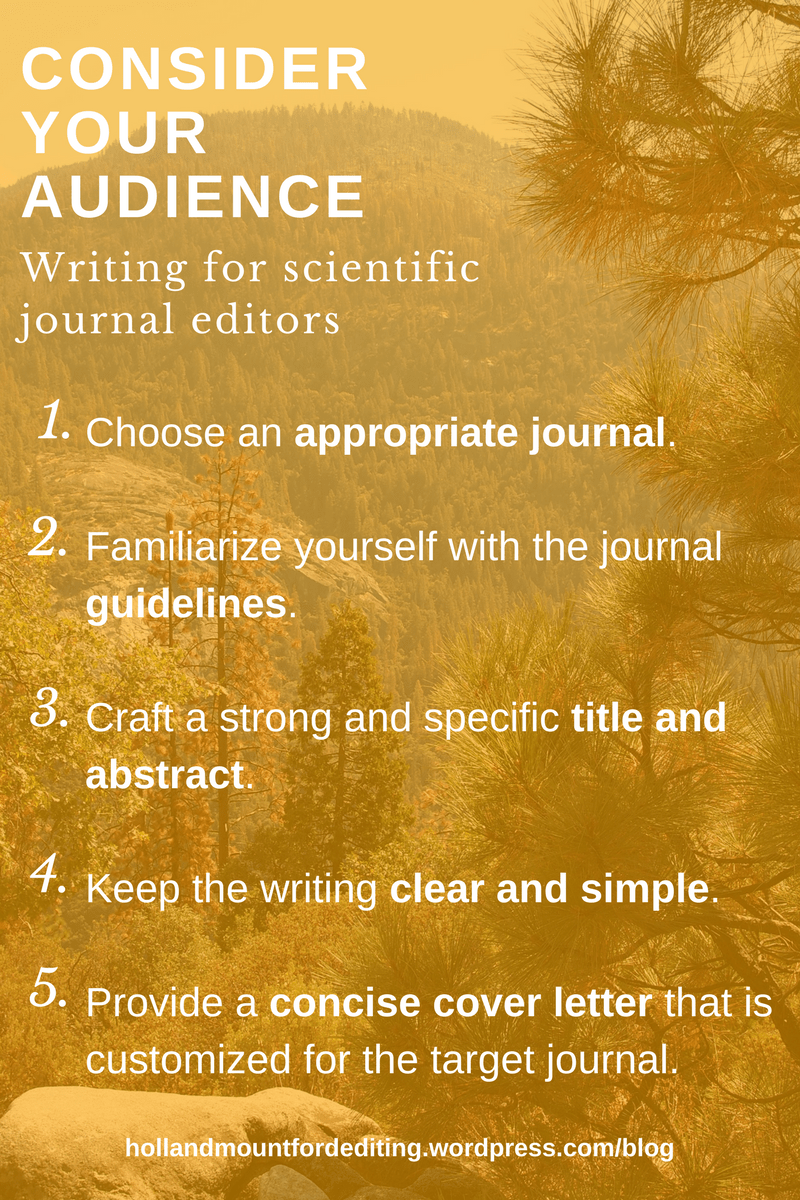
Consider your audience: Writing for scientific journal editors

It is easy to feel overwhelmed or uncertain of how to proceed when preparing a scientific manuscript, grant application, or conference abstract. I have gathered some advice from journal editors that may guide your writing process. Although these tips are for journal articles, many of them apply to other types of academic writing.

Continue reading “Consider your audience: Writing for scientific journal editors”

Science writing tip #4: Read with a critical eye

You can improve your science writing by reading critically to understand scientific article structure and writing conventions.

This tip applies to all writers, scientists and non-scientists alike: you should read to improve your own writing. As scientists, we read to add to our understanding of our research fields. However, it is also important to read research articles to understand how they are structured and to recognize the most effective communication strategies.

Continue reading “Science writing tip #4: Read with a critical eye”

Science writing tip #2: Academic does not mean long and complicated

Academic writing should be clear and concise. Long, complicated sentences are not necessary to maintain a formal, academic tone.

Although you must maintain an academic style when writing  journal articles and grant applications, you should aim to express your ideas clearly and concisely. When you are writing about technical procedures in a specialized field, it is easy for your writing to become overly complicated. Writing in a straightforward manner will make your work easy to understand and put the emphasis on the content rather than the style.

Continue reading “Science writing tip #2: Academic does not mean long and complicated”

Science writing tip #1: Read the guidelines

The advantages of reading the guidelines before preparing your scientific article, abstract, or grant application.

This tip is simple, but effective. You can save a considerable amount of time by starting your article preparation by carefully reading the guidelines provided by your target journal, conference, or funding agencies.

Continue reading “Science writing tip #1: Read the guidelines”